China Defence Minister Dong Jun urges nations to reject coercion as Taiwan, Japan, South China Sea and regional security tensions rise.
China Defence Chief Warns Against Coercion Amid Regional Tensions
China’s Defence Minister Dong Jun has called on countries to avoid provocative actions and work together to prevent the return of militarism, historical revisionism and other destabilising trends.
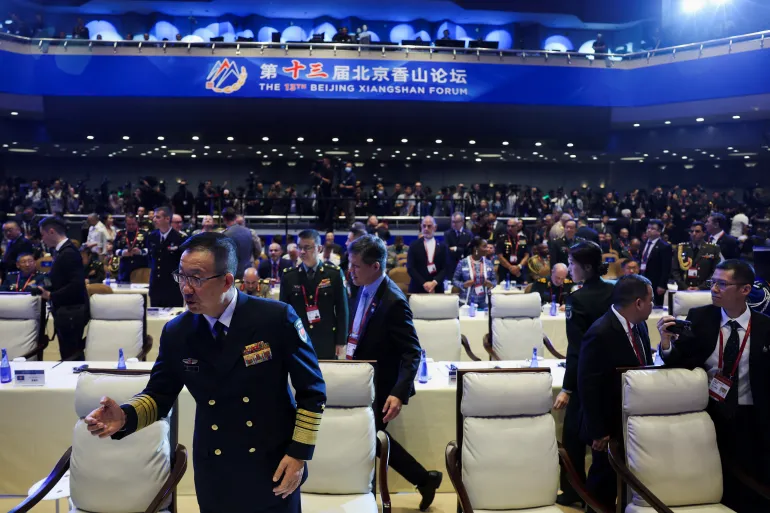
Speaking at the opening of the 13th Beijing Xiangshan Forum, Dong urged nations to adopt a more inclusive approach to resolving international disputes. His remarks came at a time of growing tensions across the Asia-Pacific, particularly over Taiwan, the South China Sea and China-Japan relations.
Although Dong did not directly name the United States or Japan in his main address, his comments about militarism and historical revisionism were widely viewed as relevant to Beijing’s concerns about Japan’s expanding defence role in the region.
“We must bear the lessons of history in mind,” Dong said, stressing the need for vigilance against what he described as hegemony, militarism and historical revisionism.
He also called for international cooperation to prevent what he characterised as a resurgence of negative historical trends.
China Calls for Greater Military Cooperation
Ahead of the main forum, Dong held meetings with defence officials from several countries, including Myanmar, Brunei, Belarus, Azerbaijan, Kyrgyzstan and Armenia. He also met ASEAN Secretary-General Kao Kim Hourn.
During those meetings, Dong promoted closer military cooperation and a broader concept of shared security. China has increasingly used the Beijing Xiangshan Forum as an important platform for military diplomacy and discussions on international security.
The three-day forum brings together military officials, diplomats, academics and security experts from numerous countries. China has used the gathering to promote its vision of a multipolar international system and to call for greater participation by developing countries in global security affairs.
The forum is taking place against the backdrop of heightened tensions in the Asia-Pacific. Taiwan remains one of the most sensitive issues in China’s relations with the United States and its regional partners, while competing territorial claims and military activities continue to create friction in the South China Sea.
Japan Emerges as a Major Focus
Japan was a significant underlying issue surrounding this year’s discussions, despite the absence of direct criticism of Tokyo in Dong’s opening remarks.
Relations between China and Japan have deteriorated amid disagreements over Taiwan and Japan’s increasingly active security policy in the region.
Beijing regards Taiwan as part of China and has increased military activity around the island in recent years, including large-scale exercises. Taiwan’s authorities reject Beijing’s sovereignty claims and maintain that the island’s future should be determined by its people.
A Chinese maritime affairs scholar attending the forum argued that Japan’s growing involvement in the South China Sea could create long-term challenges for regional stability.
He suggested that Japan’s activities could affect maritime cooperation, negotiations over regional rules and efforts to develop a Code of Conduct for the South China Sea.
These comments reflect Beijing’s broader concern about the expanding security cooperation between Japan, Southeast Asian countries and other regional partners.
US-China Relations Remain Important
The forum is also taking place as China-US relations remain closely watched. The timing is particularly significant because Chinese President Xi Jinping is expected to travel to Washington for talks with US President Donald Trump.
Dong avoided directly criticising Washington in his speech, instead presenting China’s position through broader calls for dialogue, cooperation and opposition to coercive behaviour.
The United States remains a central security partner for several countries in the Asia-Pacific, while China has expanded its military and diplomatic engagement across the region.
For many Southeast Asian governments, maintaining stable relations with both Beijing and Washington has become an increasingly important foreign-policy challenge.
Regional Countries Seek Balance
The attendance of senior defence officials from countries across Asia and beyond highlights the complex security environment facing the region.
Vietnamese Defence Minister Phan Van Giang and Malaysian Vice Defence Minister Adly Zahari are among the senior representatives attending the forum. North Korea is also represented by a delegation from its Ministry of National Defence led by Vice Minister Kim Kang Il.
The participation of countries with different relationships with China and the United States demonstrates the wider importance of regional security discussions.
For Beijing, the Xiangshan Forum provides an opportunity to promote military diplomacy, strengthen defence ties and present its perspective on global security.
For participating countries, the gathering offers a venue to discuss issues ranging from territorial disputes and military cooperation to regional stability and the changing balance of power in the Asia-Pacific.
As tensions involving China, Japan, the United States and Taiwan continue, calls for dialogue and restraint are likely to remain central to regional security discussions.