Italy faces nationwide protests as students and unions demand education funding, lower living costs and an end to Middle East wars.
Italy Tightens Security as Students and Unions Launch Nationwide Protests
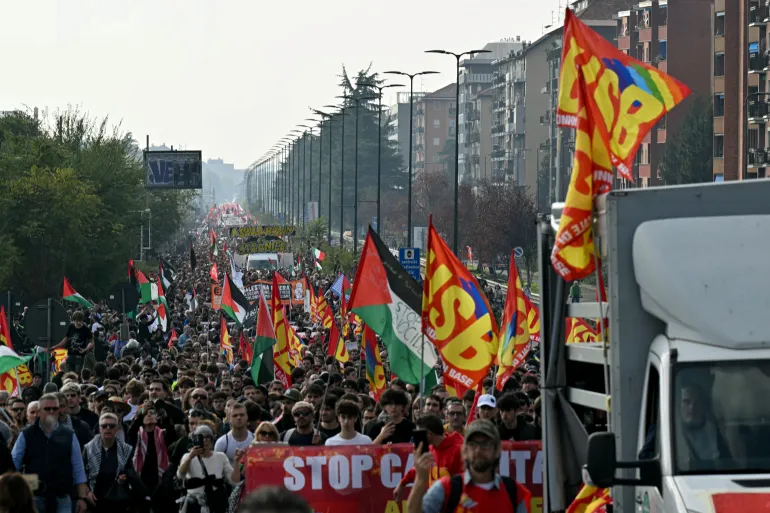
Italy has increased security measures as tens of thousands of students, workers and trade union members joined nationwide demonstrations on Friday, October 30, 2026. Protesters took to the streets in dozens of cities to demand better education funding, action on rising living costs and an end to wars in the Middle East, placing fresh pressure on Prime Minister Giorgia Meloni’s government.
The demonstrations, which included a nationwide strike called by the grassroots trade union Unione Sindacale di Base (USB), brought together students, truck drivers, taxi operators, farmers and other workers. Authorities strengthened security around major landmarks and public spaces amid concerns about further unrest following violent incidents at earlier demonstrations.
Rome, Milan and Naples were among the cities affected. Although most demonstrations were focused on economic and political demands, clashes between protesters and riot police were reported in Turin.
Italy Deploys Heightened Security Amid Growing Protests
Italian authorities adopted additional security precautions ahead of Friday’s demonstrations, reflecting concerns about public disorder following unrest in several cities earlier in October.
Security was reinforced around Rome’s Colosseum, one of the country’s most visited tourist attractions. Additional protection was also provided around Milan Cathedral as large crowds gathered in the northern city.
The measures come as Meloni’s right-wing government faces mounting criticism over the cost of living, public services, education spending and its approach to international conflicts.
According to Al Jazeera’s October 30 report, demonstrations took place in dozens of Italian cities. Police maintained a visible presence, while some confrontations occurred during the early stages of a protest in Turin. Rallies were also reported in Bologna and Genoa.
The latest mobilisation follows earlier demonstrations that occasionally escalated into clashes, looting and property damage. Those incidents prompted the government to introduce tougher public-order measures and increase security deployments.
Students Demand More Funding for Education
Education was among the central issues driving Friday’s demonstrations.
High school and university students joined marches to demand greater investment in schools and universities, alongside improved support for young people struggling with housing costs.
Students and their supporters have raised concerns about the resources available to educational institutions and the financial difficulties facing younger generations.
The protests also reflect wider frustration about the affordability of everyday life. Rising housing expenses, food prices, energy bills and transportation costs have become major concerns for Italian households.
For many demonstrators, education funding and economic conditions are closely connected. Students argue that limited opportunities, expensive housing and financial insecurity make it increasingly difficult for young people to plan their futures.
The participation of different generations and professional groups gave the demonstrations a broader character than a student-led campaign alone.
Trade Unions Call for Strike Over Living Costs and War
The USB trade union played a significant role in organising Friday’s nationwide mobilisation, calling for a general strike that attracted participants from several sectors.
Truck drivers, taxi drivers and farmers were among the workers joining the demonstrations.
Economic grievances were a major part of the strike’s demands. Workers have expressed concern about increasing fuel prices, rising household expenses and government decisions on public spending.
However, the demonstrations also included a strong international political message.
Trade unions from Italy joined counterparts in France, Greece, Spain, Turkiye and Morocco in calling for an end to wars in the Middle East, including the war in Gaza.
The unions also opposed the use of commercial ports for transporting military supplies.
In a joint statement reported by Al Jazeera, the organisations argued that dockworkers should not be involved in moving weapons, ammunition, military equipment or troops.
The position highlights how domestic labour protests in Italy have become connected to wider European and international campaigns opposing military escalation.
Rising Prices Continue to Put Pressure on Italian Households
The demonstrations come amid growing economic pressure on Italian families and businesses.
According to figures cited in Al Jazeera’s reporting, the prices of food, energy, transportation and household bills in Italy have increased by 68 percent since 2000. Over the same period, average wages have declined by almost 5 percent.
Higher fuel prices have been particularly difficult for transport companies, farmers and fishermen, whose operating expenses have increased significantly.
The economic pressure has also contributed to protests and road blockades in southern Italy. Truck drivers previously organised demonstrations that disrupted deliveries and contributed to shortages of food and fuel in some areas.
In response, the government agreed last week to provide a €175 million ($195 million) support package for truck drivers, farmers and fishermen affected by rising fuel costs.
The assistance is intended to ease financial pressure on industries that depend heavily on fuel and transportation.
However, the demonstrations on October 30 indicate that government support measures have not resolved the wider concerns surrounding household expenses, wages and public investment.
Meloni Government Faces Pressure Over Security and Public Spending
The protests present a political challenge for Prime Minister Giorgia Meloni, whose government has faced criticism over its handling of economic difficulties and public demonstrations.
Following violent incidents in Milan during the weekend of October 17–18, authorities introduced tougher measures governing public gatherings and expanded certain powers relating to the detention of minors.
During those incidents, groups of predominantly young people looted businesses, damaged shop windows and clashed with police.
The government has defended stronger security measures as necessary to maintain public order. Meloni has also distinguished between peaceful demonstrations and acts of vandalism.
Meanwhile, the government is discussing its draft 2027 budget, which includes proposed assistance for younger workers and families.
One measure under consideration is an annual €2,500 bonus for workers under the age of 30.
Speaking at a news conference on Wednesday, Meloni said she hoped the proposed measures would address concerns among young people who felt neglected by the state. She also stressed that the assistance was not intended for people involved in vandalism.
The debate over public spending has become increasingly important as protesters question whether government priorities adequately address education, employment, living costs and social services.
What Happens Next?
Italy’s nationwide demonstrations on October 30 highlight the growing connection between student activism, labour disputes and opposition to rising living costs.
The protests have brought together groups with different immediate concerns, including students seeking better educational opportunities, workers demanding improved financial conditions and unions opposing military escalation in the Middle East.
Although the government has announced financial assistance and strengthened public security, dissatisfaction over economic conditions remains evident.
For now, authorities continue to monitor demonstrations amid concerns about further confrontations. The latest protests also underline the political difficulties facing Meloni’s administration as it balances public-order policies with demands for greater investment in education and economic support.
The October 30 mobilisation represents another significant demonstration of public discontent in Italy, with the government’s response to living costs, public services and security likely to remain central to the country’s political debate.