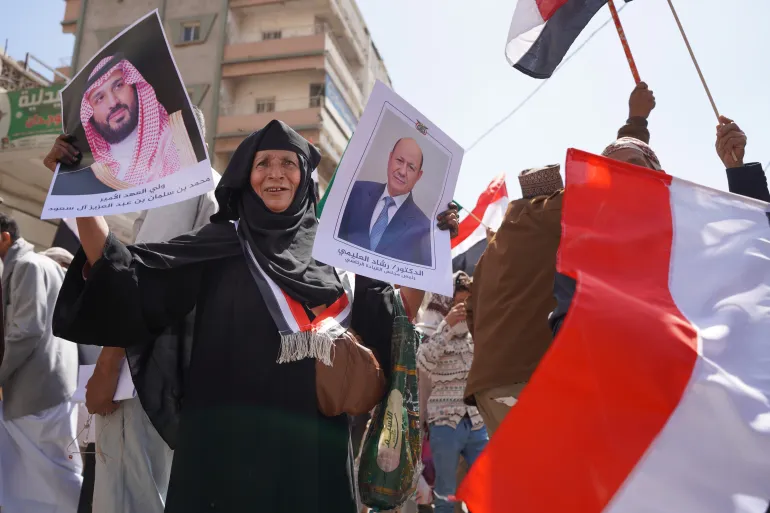
Yemen leader Rashad al-Alimi urges public mobilisation against Houthi forces and offers amnesty to fighters who defect to government forces.
Yemen Leader Urges Public Mobilisation Against Houthi Forces
Yemen’s Presidential Leadership Council Chairman Rashad al-Alimi has called on the country’s population to mobilise and support government forces as fighting with the Houthis intensifies near the strategically important Bab al-Mandeb strait.
In a recorded speech on Friday, al-Alimi urged Yemenis to join the country’s armed and security forces through official channels and contribute to efforts aimed at confronting the Houthi movement.
The appeal came after government-backed forces suffered setbacks along Yemen’s western Red Sea coast as Houthi fighters continued to make advances in areas of strategic importance.
Al-Alimi called for what he described as a broad national mobilisation, encouraging Yemenis to support the internationally recognised government in whatever capacity they can.
“I call on the sons of our great people to engage in a general mobilisation and national mobilisation to rally around their armed and security forces,” he said.
Yemen Government Seeks to Retake Sanaa
The Yemeni government has reiterated its objective of restoring state control over the country, including the capital, Sanaa.
The Houthis seized control of Sanaa in 2014, triggering a prolonged conflict that has drawn in regional powers and created one of the Middle East’s most serious humanitarian and security crises.
Al-Alimi said the government’s objective remains restoring state institutions and extending government authority throughout Yemen.
“Our objective is clear to everyone both at home and abroad: to restore state institutions and exercise their sovereignty over the entire country, including Sanaa,” he said.
His speech was delivered on the 64th anniversary of the military coup that ended the monarchy in northern Yemen in 1962. The anniversary comes as the country remains divided between competing political and military authorities.
Amnesty Offered to Houthi Defectors
Alongside his call for mobilisation, al-Alimi announced an immediate amnesty for Houthi fighters who abandon the group and join government forces.
He said the pardon would apply to individuals who leave the Houthi movement, provided the amnesty is granted through the appropriate constitutional and legal procedures.
The offer is intended to encourage Houthi fighters to defect and could become part of the government’s broader effort to strengthen its military position against the group.
The announcement comes as tensions continue to rise across Yemen and the wider region. Fighting around the Red Sea and Bab al-Mandeb has increased concerns about regional security, shipping routes and the potential for the Yemen conflict to expand further.
Saudi Arabia Strengthens Regional Coordination
The latest developments in Yemen are also unfolding alongside increased military coordination between Saudi Arabia and its regional partners.
On Friday, the military chiefs of staff of Saudi Arabia, Turkiye and Pakistan held their first meeting under the trilateral defence agreement known as the Mecca Pact.
The meeting took place amid continuing Houthi attacks and heightened security concerns involving Saudi territory.
Saudi Arabia has played a central role in supporting Yemen’s internationally recognised government during the conflict, while the Houthis have maintained control over large parts of northern and western Yemen.
Missile and Drone Threats Continue
On Saturday, the Saudi-led coalition said its air defence systems intercepted a ballistic missile launched by the Houthis toward Khamis Mushait in Saudi Arabia.
The coalition also reported intercepting two drones that were heading toward Riyadh.
The reported attacks highlight the continuing security threat posed by the Houthi movement beyond Yemen’s borders. Saudi Arabia has repeatedly faced missile and drone attacks during the Yemen conflict.
The latest developments have also raised concerns over the security of the Bab al-Mandeb strait, one of the world’s most important maritime chokepoints. The waterway connects the Red Sea with the Gulf of Aden and is a major route for international commercial shipping.
Yemen Conflict Remains Unresolved
Despite years of military operations and diplomatic efforts, Yemen remains politically and militarily divided.
The internationally recognised government continues to seek the restoration of state authority across the country, while the Houthis retain control over significant territory and major population centres.
Al-Alimi’s latest call for military mobilisation and his offer of amnesty to Houthi defectors signal a renewed government effort to strengthen its position on the battlefield.
With fighting continuing and regional military coordination increasing, developments in Yemen remain closely linked to wider security concerns across the Red Sea and Middle East.