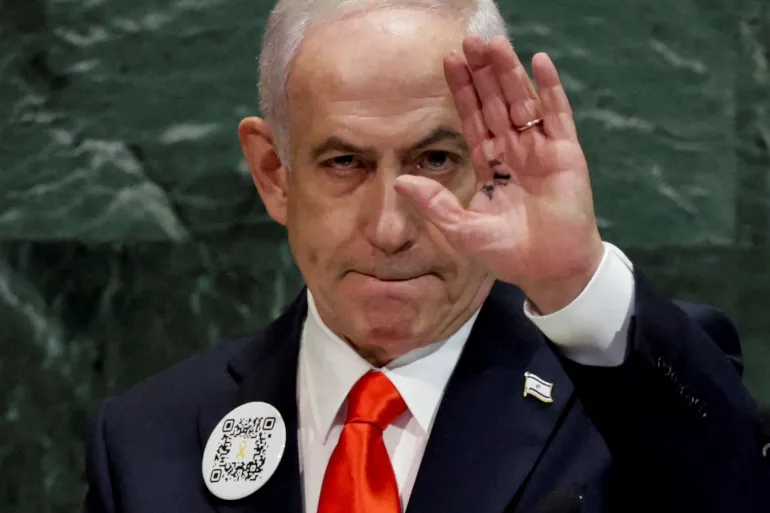
Netanyahu’s UN speech comes as Israel faces global criticism, Gaza tensions and a crucial election, putting his leadership under scrutiny.
Netanyahu UN Speech: Israel Election Stakes Rise
Israeli Prime Minister Benjamin Netanyahu is set to address the United Nations General Assembly in New York at a politically sensitive moment for both Israel and his own political career. His appearance comes as Israel faces growing international criticism over its military actions in Gaza and the occupied West Bank, while domestic political tensions are increasing ahead of crucial elections later this year.
Netanyahu’s upcoming UN speech will be his 15th appearance before the General Assembly. In Israel, his speeches at the United Nations have traditionally attracted extensive television coverage and generated significant political discussion. This time, however, the address carries additional importance as Netanyahu seeks to reinforce his image as Israel’s leading voice on the international stage.
Political analysts say the prime minister is likely to use the speech to address international criticism, emphasize Israel’s security concerns and highlight the country’s relationship with the United States. The threat posed by Iran is also expected to feature prominently in his remarks.
Israel’s Long-Running Dispute With the UN
Israel’s relationship with the United Nations has been contentious for decades. Israeli governments have frequently criticized the organization over resolutions concerning the Israeli-Palestinian conflict, the occupation of Palestinian territories and Israel’s military operations.
The situation has become even more contentious since the October 7, 2023 attack and the subsequent war in Gaza. International organizations and investigators have raised allegations involving possible war crimes and other serious violations. Israel has rejected many of these accusations and has repeatedly argued that international criticism reflects what it considers institutional bias against the country.
The United Nations has also remained deeply involved in humanitarian operations in Gaza and the West Bank. Its agencies have provided aid, medical assistance and other essential services despite the severe restrictions and security challenges surrounding access to affected areas.
Israel’s government has increasingly taken a confrontational position toward some UN institutions. Relations have deteriorated further following disputes involving the UN secretary-general and the UN agency responsible for Palestinian refugees.
Netanyahu’s Domestic Political Challenge
Although the UN speech is an international event, its political impact inside Israel could be just as important. Netanyahu has frequently presented himself as an experienced international statesman capable of defending Israel against pressure from other countries.
With elections approaching, the speech provides an opportunity to communicate directly with Israeli voters. Political observers expect Netanyahu to emphasize national security, relations with Washington and the continuing threat from Iran.
The address could also dominate Israel’s news cycle because UN speeches by the prime minister have become major domestic political events. Supporters are likely to view the appearance as an opportunity for Netanyahu to defend Israel’s interests internationally, while opponents may focus on the country’s diplomatic isolation and the government’s handling of the Gaza conflict.
US Support Remains Central
The United States remains a crucial factor in Israel’s international position. Washington has continued to provide strong diplomatic support for Israel at the United Nations since the October 7 attack.
The United States has repeatedly used its veto power at the UN Security Council to block resolutions concerning the Gaza war that it has opposed. Several proposed resolutions have called for ceasefires or other measures related to the conflict.
At the same time, the continuing disagreement between Israel and international institutions has highlighted broader questions about the effectiveness of the UN in responding to major conflicts.
The UN Security Council’s veto system gives its five permanent members substantial power over major international decisions. Critics argue that this structure can prevent the organization from taking decisive action during major conflicts.
Gaza and the Future of the UN
The Gaza war has placed the United Nations under intense pressure. Humanitarian agencies continue to provide assistance, but access, security conditions and political disagreements have created major obstacles.
Analysts also point to conflicts in other parts of the Middle East and Africa as evidence of the challenges facing the international organization. The UN’s ability to influence political outcomes depends heavily on cooperation among its member states.
For Netanyahu, the UN General Assembly appearance therefore carries two distinct messages. Internationally, it is an opportunity to present Israel’s position to world leaders. Domestically, it is a chance to reinforce his political image as a leader willing to confront international pressure.
As Israel moves closer to its next election, Netanyahu’s UN speech is likely to receive substantial attention. Its significance will depend not only on what he says in New York, but also on how Israeli voters interpret his message amid continuing war, diplomatic tensions and intense political debate.