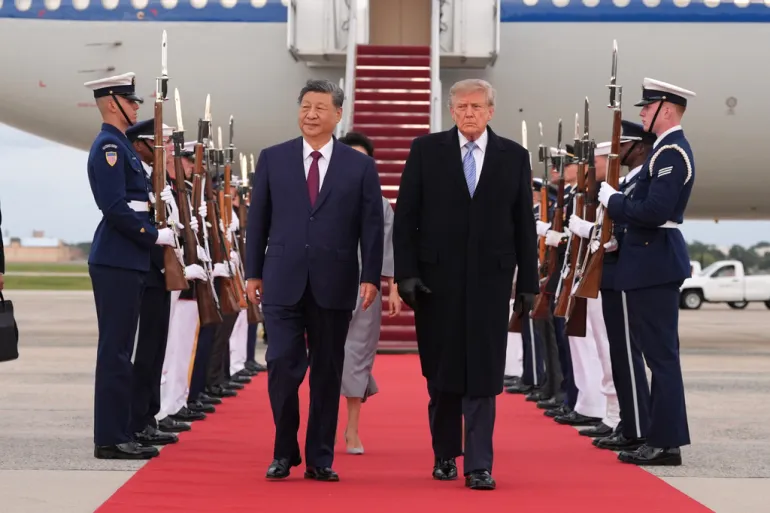
Trump-Xi summit focuses on US-China trade, tariffs, AI, Taiwan and critical minerals as both sides seek to stabilise relations.
Trump-Xi Summit: US-China Ties in Focus
The meeting between US President Donald Trump and Chinese President Xi Jinping is expected to focus less on major trade agreements and more on preventing further deterioration in US-China relations.
Trump has given Xi a high-profile welcome as the Chinese leader begins a three-day visit. The programme includes a state banquet and a military flyover, underscoring the importance both governments are placing on the summit.
Despite the elaborate welcome, analysts say expectations for major breakthroughs should remain limited. Instead, the meeting is expected to centre on rebuilding trust, maintaining a fragile trade truce and keeping communication open between the world’s two largest economies.
US-China Trade War Remains a Major Issue
Trade will remain one of the most important issues during the Trump-Xi summit. The United States and China have been locked in a prolonged trade dispute involving tariffs, technology restrictions and controls over strategically important products.
The confrontation began during Trump’s first presidency, when Washington imposed tariffs on a range of Chinese industrial imports. Beijing responded with tariffs on American products, including agricultural goods and other exports.
Some of those policies remained in place under former President Joe Biden, who also introduced restrictions targeting China’s access to advanced semiconductor technology.
Relations deteriorated further during Trump’s second term after the US introduced additional tariffs on Chinese goods. At one point, Washington threatened tariffs as high as 200 percent on Chinese imports. Beijing responded with warnings of retaliation and restrictions on the export of critical minerals.
These minerals are essential to numerous industries, including electronics, automobiles, renewable energy and advanced manufacturing.
Although both countries have since stepped back from the most severe escalation, tariffs remain high. The two governments therefore have strong economic reasons to prevent another major breakdown in relations.
Critical Minerals and Trade Truce
A key objective for Washington is maintaining access to China’s critical mineral supplies.
Following an earlier meeting between Trump and Xi in Busan, China resumed shipments of critical minerals. US officials now want those supplies to move more quickly and reliably.
Analysts suggest the summit could therefore produce limited measures designed to preserve the existing trade truce.
One possible development is a new trade mechanism under which the United States and China could reduce tariffs on selected goods. Such an arrangement would represent a limited step toward normalising economic relations without resolving the broader trade dispute.
For businesses and global markets, even modest improvements in US-China trade relations could reduce uncertainty surrounding supply chains and international commerce.
Artificial Intelligence Creates New Challenges
Artificial intelligence is another sensitive issue on the summit agenda.
Washington has discussed creating a direct US-China dialogue on AI safety, including the possibility of an AI hotline for reporting incidents that could pose national security risks.
However, deep mistrust between the two countries could make meaningful cooperation difficult.
The United States continues to restrict China’s access to advanced semiconductor technology, while American officials have described competition with China over AI as strategically important.
Beijing, meanwhile, is seeking a greater role in shaping international AI governance. China also views AI technology as an important tool for expanding its global influence.
These competing objectives could limit the possibility of major agreements on AI during the summit.
Iran and Taiwan Add to the Pressure
The leaders are also expected to discuss Iran, although significant cooperation may be difficult.
China has important economic ties with Iran and has historically purchased substantial quantities of Iranian oil. Beijing also maintains commercial links involving products and components with potential military applications.
Another major issue is Taiwan.
China considers Taiwan part of its territory, while Taiwan operates under its own democratic government and rejects Beijing’s claims of sovereignty. The United States has longstanding security and economic ties with Taiwan, making the issue one of the most sensitive points in US-China relations.
Taiwan is also watching Washington closely over a proposed US arms package. Any change in American policy toward Taiwan could have major consequences for relations between Washington and Beijing.
Why the Trump-Xi Summit Matters
Even without a major agreement, the summit carries significant international importance.
The United States and China have enormous trade and economic relationships, meaning their disputes can affect global supply chains, commodity markets, technology companies and economies around the world.
For Trump, the high-profile visit also provides an opportunity to demonstrate American diplomatic engagement on the global stage. For Xi, improving the economic relationship with the United States could be important as China deals with domestic economic challenges.
Ultimately, the Trump-Xi summit is likely to be measured less by a dramatic new agreement and more by whether both governments can prevent another escalation.
Maintaining dialogue, protecting critical mineral supplies, reducing trade tensions and establishing greater communication on sensitive issues could provide the foundation for a more stable US-China relationship.

