Trump rallies Latin American allies to target drug cartels, impose sanctions and strengthen regional cooperation against narco-terrorism.
Trump Rallies Latin American Allies Against Drug Cartels
US President Donald Trump has called on Latin American allies to take stronger action against drug cartels and criminal organisations across the Western Hemisphere, promising to use what he described as “unmatched military might” in the fight against transnational crime.
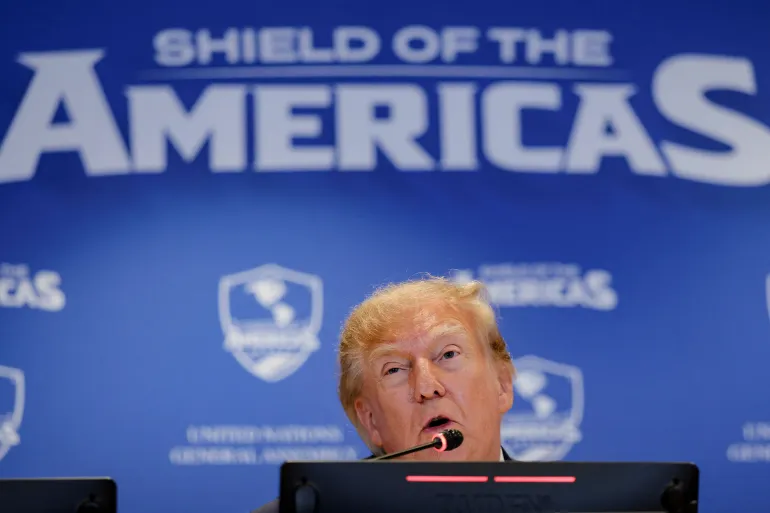
Trump made the remarks during a meeting of the Shield of the Americas, a US-led coalition focused on combating drug trafficking, organised crime and groups considered threats to regional security. The meeting was held in New York alongside the annual United Nations General Assembly.
Trump urged the participating governments to cooperate with the United States in targeting 24 criminal organisations. He has previously compared these groups with ISIS and called for them to be treated as major security threats.
He also called on members of the coalition to formally designate what he described as narco-terrorist groups as common threats to regional stability. Trump urged participating governments to introduce strong sanctions against the organisations, their members and their supporters.
The 15 participating governments subsequently issued a joint statement outlining plans to pursue measures including asset freezes, visa restrictions and criminal charges against individuals associated with the targeted organisations.
Major Cartels and Criminal Groups Targeted
The list includes several of Latin America’s most prominent criminal and armed groups.
Among them are Mara Salvatrucha, commonly known as MS-13, and Tren de Aragua, a Venezuelan criminal organisation with activities reported in several South American countries.
The list also includes major Mexican drug cartels, Colombia’s National Liberation Army, Brazil’s Primeiro Comando da Capital and Comando Vermelho, as well as Peru’s Shining Path.
However, the implementation of the new measures will depend on the laws and procedures of individual countries. In some nations, governments may need legislative approval before sanctions or other legal measures can be introduced.
This means that although the agreement represents a significant step toward closer cooperation, its practical consequences may take time to emerge.
US Push for Stronger Anti-Cartel Cooperation
The Trump administration has increasingly focused on drug cartels, illegal drug trafficking and transnational organised crime as major national security concerns.
Since returning to office, Trump has designated several cartels as foreign terrorist organisations and authorised military action against suspected drug-trafficking operations. US officials have said that strikes against boats in the Caribbean and eastern Pacific were aimed at vessels carrying illegal narcotics toward the United States.
The military campaign has generated significant international controversy. United Nations experts have raised concerns about the legality of some of the operations and warned that certain actions could potentially violate international law.
Trump’s broader foreign policy strategy has also placed greater emphasis on US influence in the Western Hemisphere. His administration has discussed a renewed version of the Monroe Doctrine, the historic US policy associated with American influence across Latin America and the Caribbean.
These developments have generated concern among some governments in the region, particularly over questions surrounding sovereignty, military intervention and the expansion of US influence.
Latin American Governments Take Different Positions
The Shield of the Americas coalition includes governments considered closely aligned with the Trump administration, including Argentina, Ecuador and El Salvador.
Colombia and Peru have also joined the initiative following changes in their respective governments. Meanwhile, Brazil and Mexico have not joined the coalition, highlighting differences among major Latin American countries over the US-led approach to combating organised crime.
US Secretary of State Marco Rubio welcomed what he described as the emergence of strong regional leaders willing to confront transnational criminal organisations.
Supporters of the initiative argue that closer international cooperation could help governments tackle drug trafficking networks that operate across national borders. Critics, however, have raised concerns about the potential consequences of expanding military involvement in the fight against organised crime.
Brazilian President Luiz Inacio Lula da Silva has expressed opposition to what he views as renewed attempts at regional dominance. In remarks at the United Nations, Lula stressed Brazil’s independence and sovereignty, declaring that Brazil is nobody’s backyard.
The competing positions demonstrate the growing debate over how Latin American governments should respond to drug cartels, narco-terrorism, organised crime and US security policy.
As the Shield of the Americas develops, its effectiveness will depend on how participating countries translate the agreement into domestic laws, sanctions, law-enforcement operations and international cooperation.