South Africa refugees fear renewed xenophobic attacks as a September 30 deadline raises tensions over undocumented immigration and safety.
South Africa Refugees Fear New Attacks Ahead of September 30 Deadline
Durban, South Africa — Refugees and migrants in South Africa are facing renewed fears of violence as a September 30 deadline set by the anti-immigration movement March and March approaches.
Bishop Raphael Bahebwa, a refugee from the Democratic Republic of the Congo (DRC) who has lived in South Africa for 26 years, says he is currently hiding after receiving threats over his public support for the rights of foreigners.
“I am in hiding now because they say they are going to kill me for speaking about the rights of foreigners,” Bahebwa said.
For years, South Africa has experienced periods of tension and violence involving foreign nationals. But refugees in Durban say the current situation feels particularly worrying, especially with the September 30 deadline and local government elections scheduled for November 4.
Refugees Fear Renewed Xenophobic Violence
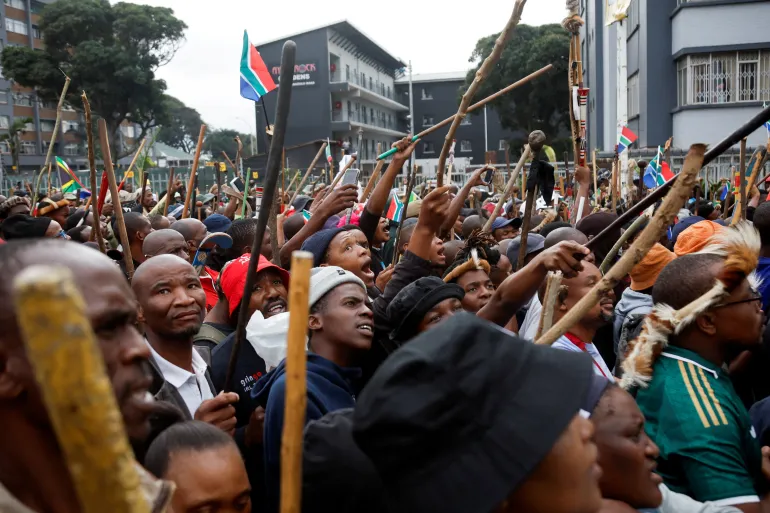
March and March has called on undocumented foreign nationals to leave South Africa and has threatened further demonstrations if its demands are not met.
The group says its campaign is focused on undocumented immigration, crime and deteriorating living conditions in South African communities. Its leaders have rejected accusations of xenophobia, arguing that their target is illegal immigration rather than foreign nationals as a whole.
However, refugees in Durban say the distinction between documented and undocumented migrants does not always protect them from hostility.
Earlier this year, six refugees working in salons around Durban’s Warwick Street Market were reportedly attacked by men carrying sticks. Two of the refugees were hospitalised.
Bahebwa says some migrants have also struggled to receive assistance from police following attacks.
“Police said we can’t open cases because we are foreigners,” he alleged. Police have not publicly responded to that specific claim.
Refugees Lived for Months Outside Immigration Office
For about four months, hundreds of refugees and asylum seekers slept on the pavement outside the Durban Refugee Reception Centre on Che Guevara Road.
Many came from the DRC and Burundi, while others were from Uganda, Mozambique and Tanzania. They said they had left their communities because they feared anti-foreigner violence and had gone to the government office seeking protection.
Instead, the pavement became their temporary home.
Men, women and children lived outside in difficult conditions, relying heavily on volunteers and civil society groups for food and other basic necessities. Some migrants described irregular access to food and medication.
They also said one man with tuberculosis died while staying at the camp, although the circumstances surrounding his death have not been independently established.
On September 3, tensions escalated when members of March and March confronted refugees and asylum seekers outside the centre. Violence broke out and police intervened, with at least four people reportedly injured.
During another protest days later, police formed a barrier between protesters and refugees as tensions increased.
Government Moves Refugees From Durban
In mid-September, authorities moved to clear the makeshift refugee camp outside the reception centre.
Those staying there were given a choice: return to the communities they had fled or accept temporary accommodation at the Lindela facility in Gauteng, hundreds of kilometres from Durban.
Lindela is a government-run immigration detention facility used for people facing deportation.
The decision divided the refugees. Some were concerned about staying at a facility associated with immigration detention and repatriation, while others said they could no longer survive on the pavement.
On September 15, 274 people were transported from Durban to Lindela, while about 150 others remained in the city and began searching for alternative accommodation.
Kafuti Muyumba, a DRC-born business owner and refugee community representative, said many people were afraid to return to neighbourhoods where they had established businesses and built their lives.
He said refugees had already lost income and livelihoods during the months of uncertainty.
“This is not the first time we are experiencing xenophobia,” Muyumba said, recalling violence in 2008 and 2015.
South Africa Tightens Immigration Enforcement
The South African government has responded to the protests by increasing immigration enforcement and strengthening border management.
Government figures show that between June 14 and August 20, authorities processed 86,596 foreign nationals for deportation and repatriation. Malawians represented the largest group, followed by Zimbabweans and Mozambicans.
The government said 90 percent of those repatriated had entered South Africa illegally, while 95 percent were classified as having crossed the border outside official ports of entry.
Officials have also warned that private groups cannot take immigration enforcement into their own hands. The September 30 deadline announced by March and March has no legal authority, and ordinary citizens cannot legally deport people from South Africa.
Despite this, refugees say the announcement has created significant fear.
For many, the concern is not simply whether they have valid documentation. They fear that anger directed at foreigners could result in violence regardless of their immigration status.
Refugees Unsure About What Comes Next
For Congolese refugees such as Muyumba, returning to the DRC is not considered a realistic option because of continuing conflict and insecurity.
“We don’t trust the police. They are not being fair with us. Some of them are also saying we must go,” he said.
Bahebwa, who has spent more than two decades building a life in South Africa, remains in hiding.
He believes the tensions surrounding immigration are unlikely to disappear when the September 30 deadline passes. With local elections approaching, refugees fear that migration could remain a major source of political and social tension.
“They are scapegoating us as foreigners,” Bahebwa said. “It is not going to end on September 30. It has to do with the elections.”