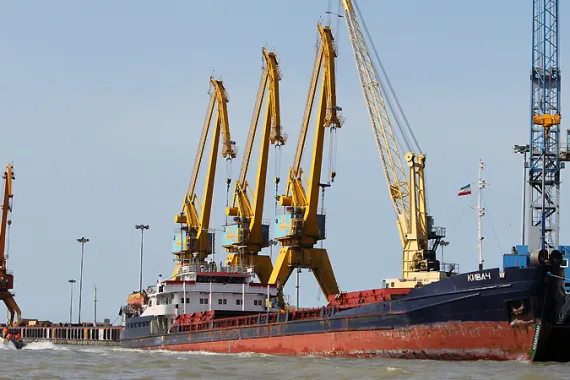
Iran is shifting trade toward the Caspian Sea as Strait of Hormuz disruptions affect oil exports, imports, ports and regional transport routes.
Iran Shifts Trade North as Hormuz Disruption Grows
Iran is increasingly looking toward the Caspian Sea and its northern borders as disruptions around the Strait of Hormuz put pressure on its traditional southern trade routes. With maritime activity in the south severely constrained, Tehran is attempting to redirect essential imports and some commercial activity through northern ports, railways and land crossings.
The shift could provide Iran with alternative trade routes, but experts say the Caspian Sea trade network cannot quickly replace the scale and capacity of the country’s major southern ports.
Caspian Sea Trade Faces Major Challenges
The Caspian Sea offers Iran a direct maritime connection with Russia, Kazakhstan, Turkmenistan and other regional markets. However, declining water levels have created an additional obstacle for shipping.
Water levels in the Caspian have fallen significantly over recent decades, reducing the size of vessels that some Iranian ports can accommodate. Ports that previously handled ships carrying around 6,000 tonnes may now be limited to vessels of approximately 4,000 tonnes.
Lower water levels have also affected shipping through Russia’s Volga River, an important connection between the Caspian Sea and wider Russian waterways. Some Iranian vessels have reportedly faced delays because of difficult navigation conditions.
These limitations make it difficult for Iranian northern ports to absorb a large portion of the cargo normally handled by southern terminals.
Iran Increases Reliance on Northern Ports
Iran has traditionally depended heavily on ports along the Persian Gulf and Gulf of Oman for international trade, particularly for oil, fuel, minerals and other bulk commodities.
Northern ports, including Anzali, Amirabad and Nowshahr, have a much smaller combined capacity. Iran’s overall port capacity is estimated at about 300 million tonnes, while northern ports account for only around 30 million tonnes.
Nevertheless, the share of essential goods handled by northern ports has increased substantially. Food products such as wheat, maize, barley and oilseeds are among the commodities being prioritized as Iran seeks alternative import routes.
Container traffic has also increased, reflecting growing demand for northern trade corridors. The geographical location of these ports could provide another advantage because they are relatively close to major Iranian population and industrial centers, including Tehran, Isfahan and Arak.
Shorter inland transport distances could help reduce some logistics costs.
China, Kazakhstan and Russia Routes Gain Importance
One emerging option is the China-Kazakhstan-Iran trade route, which connects Chinese cargo by rail to Kazakhstan’s Aktau port. Goods can then cross the Caspian Sea by ship before continuing into Iran by road or rail.
The route could become increasingly important if disruptions in southern maritime trade continue.
Iran is also seeking to strengthen its position within the International North-South Transport Corridor, a network designed to connect India and other Asian markets with Russia and Europe through Iran and the Caucasus.
A key project is the Rasht-Astara railway, which would improve rail connectivity between Iran and Azerbaijan and strengthen the western section of the North-South corridor.
Completing missing railway links could make northern trade more efficient and reduce Iran’s dependence on road transportation.
Border Congestion Remains a Problem
Moving trade north does not automatically solve Iran’s logistics problems. Increased pressure on land borders has already contributed to congestion at several crossings.
Truck queues can stretch for days, while customs procedures, limited terminal capacity, road infrastructure and ongoing construction projects can create additional delays.
The lack of functioning railway connections across parts of the South Caucasus is another major obstacle. Political developments between Armenia and Azerbaijan could influence whether some historic transport routes are eventually restored or expanded.
Greater Dependence on Russia
A larger role for the Caspian Sea could also deepen Iran-Russia economic cooperation. Both countries face extensive international sanctions, making alternative financial and transport networks increasingly important.
However, relying more heavily on Russia also exposes Iran to risks associated with the wider regional security environment. Russian transport infrastructure and commercial routes can themselves face disruption because of the conflict involving Ukraine.
Security concerns have also extended into the Caspian region, raising questions about the reliability of maritime cargo routes during periods of heightened geopolitical tension.
Can the Caspian Replace Iran’s Southern Trade Routes?
The Caspian Sea can provide Iran with a valuable alternative for food imports, containerized goods and regional trade, but it is unlikely to fully replace the country’s southern maritime network in the short term.
The main limitation is scale. A large vessel operating through Iran’s southern ports can carry cargo equivalent to many smaller ships using Caspian routes.
Iran’s most valuable exports, including crude oil, petroleum products, minerals and other bulk commodities, have historically depended on southern infrastructure and access to international maritime markets.
The northern shift is therefore better understood as a strategic diversification of Iran’s trade routes rather than a complete replacement for the Strait of Hormuz.
If disruptions continue, investment in Caspian ports, railways, border crossings and the North-South Transport Corridor could become increasingly important. For Iran, developing these northern connections may provide a crucial backup system for maintaining imports and regional trade when southern routes face severe pressure.

