Sri Lanka Easter bombings verdict convicts 15 men, but victims seek answers over alleged masterminds and intelligence failures.
Sri Lanka Easter Bombings Verdict Brings Partial Justice
Colombo, Sri Lanka — More than seven years after the devastating Easter Sunday bombings of 2019, a court verdict has brought a measure of relief to victims’ families, although many say they will not feel that justice is complete until those accused of being behind the attacks are held accountable.
On the morning of April 21, 2019, tuk-tuk driver Indika Rohan took his wife and 13-year-old daughter, Kanishka Hirushi, to St Sebastian’s Church in Katuwapitiya, Negombo, for Easter Sunday Mass.
After dropping them at the church, Rohan returned to his parked tuk-tuk. Moments later, a massive explosion shook the area.
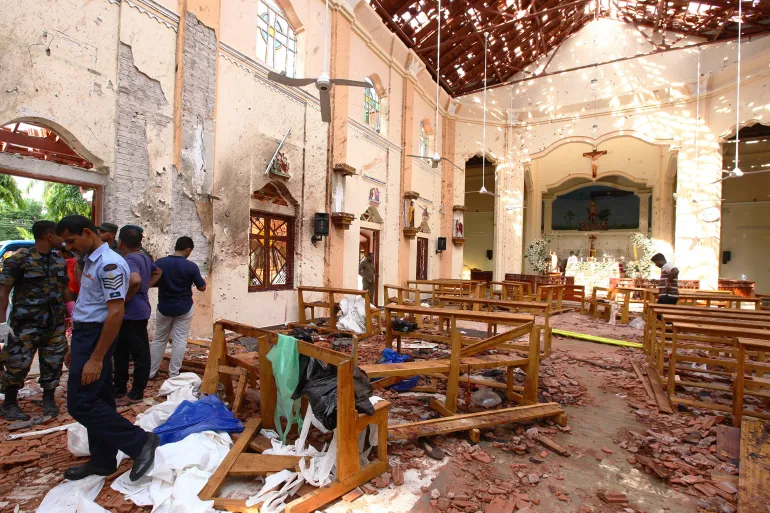
The coordinated Easter Sunday attacks targeted three churches and three luxury hotels across Sri Lanka. The bombings killed 279 people, including 45 foreign nationals, and injured more than 500 others.
Among the victims was Rohan’s daughter, who was one of 110 people killed at St Sebastian’s Church. His wife, Nilanthi Pushpakumari, 50, suffered severe injuries and spent weeks in intensive care.
“Kanishka went to church by tuk-tuk, but came home in a hearse,” Rohan said, recalling the tragedy.
Court Convicts 15 Accused
A three-judge High Court bench in Colombo has convicted 15 men in connection with the 2019 Easter Sunday attacks. The accused were found guilty of more than 23,000 charges, including murder, conspiracy to carry out terrorist attacks, and possession of firearms and explosives.
The sentences are lengthy. Five men received 200-year prison terms, another five were sentenced to 220 years, four received 240 years each, and one was given a 260-year sentence.
The court acquitted nine other accused people, while another defendant died during the proceedings.
The men who carried out the suicide bombings were believed to have died during the attacks. Authorities subsequently arrested 25 people accused of helping plan or support the operation.
For families who have spent years waiting for accountability, the verdict represents an important development.
Rohan said relatives living abroad regularly asked about the progress of the case and continued to grieve the loss of his daughter.
Questions Over Intelligence Failures
The Easter Sunday bombings also raised serious questions about whether the attacks could have been prevented.
A parliamentary investigation found that police and intelligence agencies had received warnings about a possible terrorist threat but failed to take adequate action before the attacks.
In 2023, Sri Lanka’s Supreme Court ordered several senior officials, including former President Maithripala Sirisena and former police and intelligence chiefs, to compensate victims over their failure to prevent the attacks.
However, questions surrounding the wider circumstances of the bombings remain.
One former intelligence official, Suresh Salley, was arrested in February 2026 in connection with an ongoing investigation. Allegations have been made that he had contact with members of the extremist network behind the attacks. He has denied wrongdoing.
Another controversial claim is that the bombings were politically exploited to increase public support for Gotabaya Rajapaksa during the 2019 presidential election. Rajapaksa rejected allegations that the attacks were deliberately allowed to happen for political gain.
Victims Seek Answers About the Alleged Masterminds
For survivors and bereaved families, the latest convictions may not be the end of the search for justice.
Rohan said he was closely following the investigation involving Salley and believes accountability should extend beyond those convicted in the latest case.
“The verdict gives me only partial satisfaction,” he said. “We will be fully satisfied when the remaining cases are concluded.”
Human rights activists have also called for the investigation into possible masterminds and political connections to continue. They say any evidence of individuals who planned, supported or enabled the attacks should be examined through due legal process.
Sri Lanka Continues Its Search for Justice
The Easter Sunday bombings remain one of the darkest episodes in Sri Lanka’s recent history. They also reopened painful memories of the country’s decades-long civil war, which ended in 2009 after a 26-year conflict involving the Liberation Tigers of Tamil Eelam.
Political change in Sri Lanka has since created renewed expectations for a deeper investigation.
After becoming president in 2024, Anura Kumara Dissanayake visited St Sebastian’s Church and met families affected by the bombings. He pledged to pursue a thorough investigation and uncover any political or other backing connected to the attacks.
For families such as Rohan’s, the promise is simple: they want the full truth.
Seven years after the Easter Sunday attacks, the conviction of 15 accused people has delivered a degree of justice. But for many victims, the search will continue until all outstanding questions about the 2019 Sri Lanka Easter bombings are answered through a credible and lawful investigation.

