Gaza voters prioritize jobs, security and reconstruction as Palestinian elections approach amid unemployment, displacement and economic hardship.
Gaza Voters Seek Jobs, Security Ahead of Elections
Deir el-Balah, Gaza Strip — For many people in Gaza, the upcoming Palestinian legislative elections are about much more than politics. After years of war, displacement and economic collapse, voters say they want something more basic: jobs, security, housing and a chance to rebuild their lives.
For 24-year-old Ahmad Mohsen, the election will be his first opportunity to vote in a national legislative poll. Before the war, Mohsen had graduated with a nursing degree and was preparing to complete the requirements for his professional licence. He hoped to work in a hospital, pursue a master’s degree and gain specialised training.
The war changed those plans.
During the first months of the conflict, Mohsen volunteered at Al-Aqsa Martyrs Hospital in Deir el-Balah, helping amid a constant flow of wounded and dead. But without a salary, he eventually had to find other work. He now sells prepaid internet access cards to earn a small income.
“I got tired, and I wasn’t being paid for my efforts, so I started looking for another job that would give me at least a small income,” he said.
The Palestinian legislative elections are scheduled for November 28 and would be the first such election since 2006. For young voters like Mohsen, employment is among the most important issues.
He wants future lawmakers and political leaders to address Gaza’s unemployment crisis, security concerns, housing shortages, education and healthcare.
“The first thing I want is to be able to find a stable job with a decent salary so I can support myself and my family, and the second thing is to have security,” he said.
Gaza unemployment remains a major concern
Unemployment has become one of the defining economic challenges facing Gaza. The territory’s economy has suffered enormous damage from years of restrictions and the war, leaving many graduates unable to find work.
Mohsen also worries about his family’s land east of Salah al-Din Street, where access is restricted. He hopes that the ceasefire arrangements will eventually allow greater access, reconstruction and economic recovery across Gaza.
For him, elections will only matter if they produce tangible improvements in daily life.
“A candidate should put themselves in the people’s place and speak with the people’s voice,” he said, calling for greater attention to the younger generation that has experienced years of conflict and destruction.
Memories of the 2006 Palestinian election
For 53-year-old Ghassan Marwan, the upcoming election brings back memories of the 2006 vote, the last Palestinian legislative election.
Marwan, who once worked as a goldsmith and later established a factory, remembers voting at a school in Nuseirat. He says he viewed the election as a transparent and meaningful democratic experience.
“I witnessed a great deal of transparency and integrity. It was like a democratic celebration,” he said.
His circumstances today are very different. He lost his home and factory during the war in January 2024. Decades of work were wiped out, leaving him focused on basic needs such as shelter, water, safety and rebuilding his livelihood.
“After losing your home and your source of income, what else do you want? All you hope for is reconstruction, calm and security,” Marwan said.
The war has also forced him to perform tasks he never expected to face later in life, including walking long distances to collect water.
He says political frustration has grown as people struggle to survive.
“Our interest in politics has declined, not because it does not concern us, but because of all the frustration and despair that have accumulated,” he said.
Gaza recovery is a priority for voters
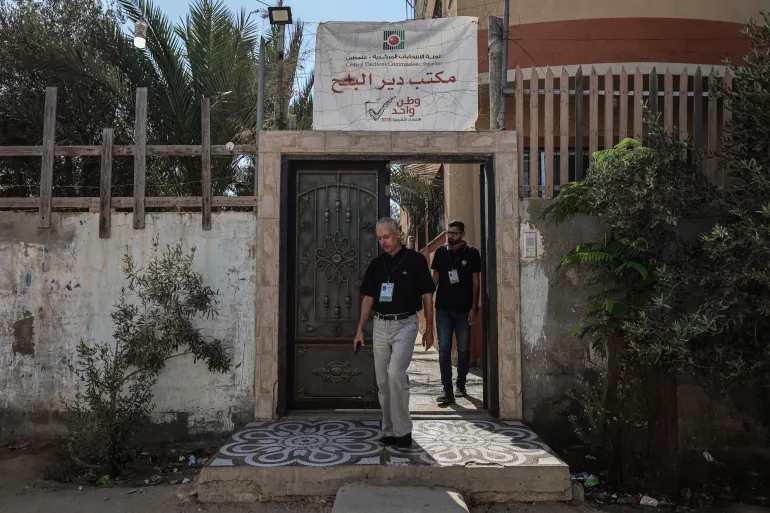
Holding elections in Gaza presents major logistical challenges. The Palestinian Central Elections Commission is preparing for voting in Gaza, the occupied West Bank and occupied East Jerusalem. The commission estimates that around 1.24 million Palestinians in Gaza could be eligible to vote.
The scale of destruction and displacement creates serious challenges for election officials. Contingency plans include producing election materials locally if supplies cannot enter Gaza.
For political analyst and writer Iyad al-Qarra, however, the war has not erased political interest among Palestinians. Instead, it has changed what many voters expect from political leadership.
After years of displacement, destroyed homes, damaged infrastructure and lost livelihoods, Gaza voters are increasingly focused on practical results.
Their priorities include rebuilding Gaza, restoring healthcare and education, repairing infrastructure, creating employment opportunities and helping families regain stable livelihoods.
The coming election therefore carries expectations that extend beyond political representation. For many Palestinians in Gaza, the central question is whether future leadership can help create the conditions for recovery, security and a return to a more normal life.
“There is a widespread desire for leadership that puts Gaza’s recovery at the top of its priorities, given the heavy price the Strip has paid,” al-Qarra said.